
Invisible Storage Tactics: When What You Don’t See Matters Most
In a world saturated with visual input, the home has become one of the few places where the mind seeks rest. Yet even well-designed interiors can feel overwhelming when everyday objects compete for attention. Invisible storage tactics respond to this problem not by adding more furniture or decorative elements, but by intentionally removing visual noise. When storage disappears into the background, space begins to feel calmer, larger, and more intentional.
The concept of invisible storage is rooted in the psychology of perception. The human brain constantly scans its environment, processing shapes, colors, and interruptions. Open shelves, exposed containers, and busy wall surfaces may appear functional, but they demand ongoing attention. Even neatly arranged items create micro-distractions. Hidden storage, by contrast, reduces the number of visual signals the brain must interpret, allowing a room to feel restful without changing its size or layout.
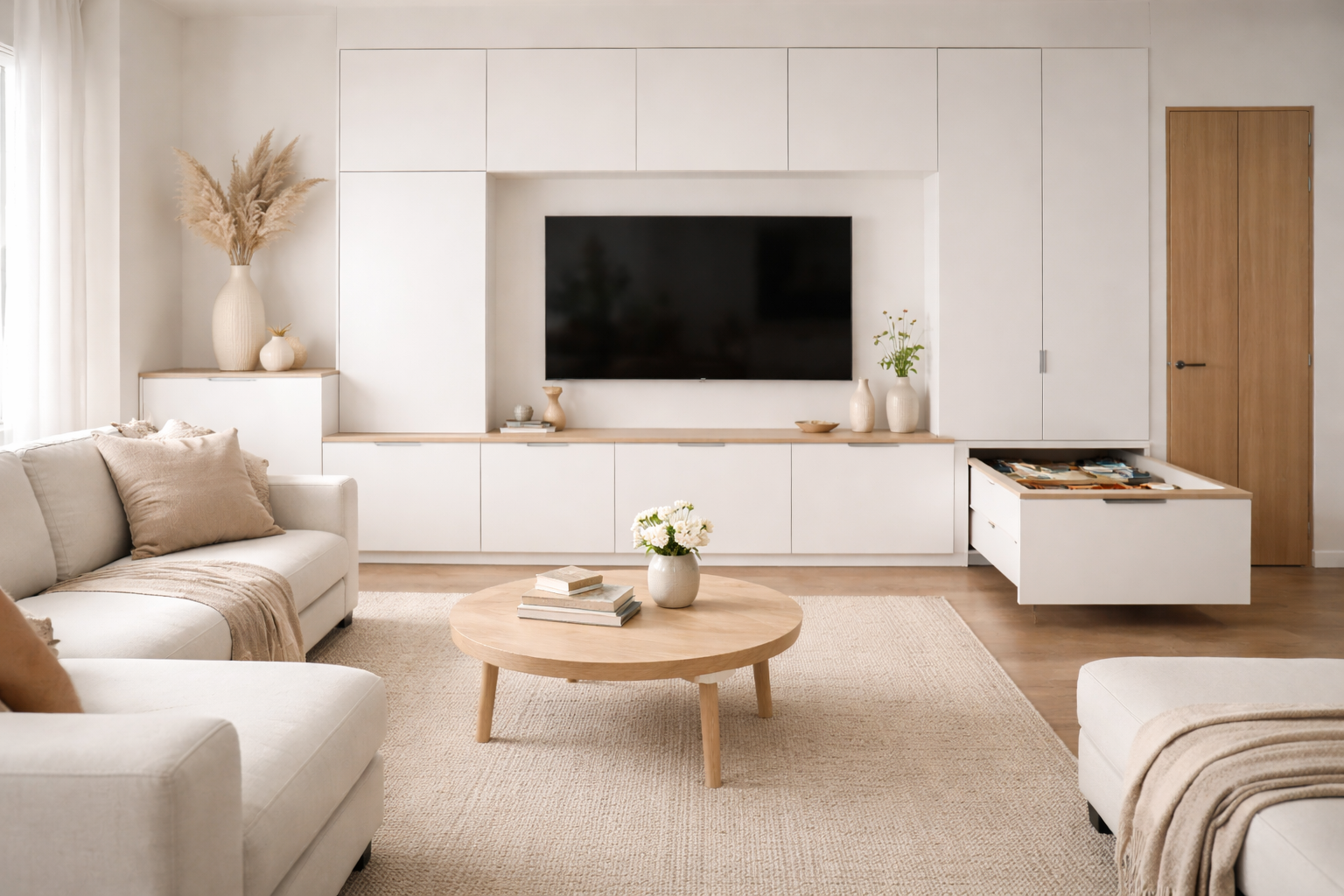
Hidden bins are one of the most effective tools in this approach. Unlike traditional storage that advertises its presence, concealed bins integrate seamlessly into furniture, closets, and architectural features. Drawers beneath beds, cabinets flush with walls, and storage hidden behind panels allow belongings to exist without being visually acknowledged. The goal is not to hide clutter carelessly, but to assign objects a place that does not interrupt the visual flow of the room.
Clean wall surfaces play an equally important role. Walls act as the largest visual fields in any interior, and how they are treated directly affects mental clarity. When walls are overloaded with hooks, shelves, frames, and organizers, they fragment the space. Invisible storage strategies favor restraint, using walls primarily as negative space. This does not mean eliminating personality, but choosing moments of emphasis rather than constant display. A largely uninterrupted wall creates breathing room for the eyes and anchors the space emotionally.
The effectiveness of invisible storage lies in its subtlety. Cabinets without visible handles, built-in units that match wall colors, and recessed storage areas blur the line between structure and function. When storage visually disappears, rooms feel less crowded even when they hold the same number of items. This illusion of simplicity encourages a more mindful relationship with possessions, as objects are accessed intentionally rather than constantly encountered.
Invisible storage also changes daily behavior. When surfaces are kept clear, cleaning becomes easier and routines feel less demanding. The absence of visual clutter reduces decision fatigue, making it simpler to focus, relax, or transition between tasks. Over time, this environment supports habits of maintenance rather than accumulation. Storage stops being a last-minute solution and becomes part of the architectural logic of the home.
This approach is especially valuable in small living spaces, where every visual interruption feels amplified. By hiding storage within existing structures and preserving clean lines, even compact rooms can feel open and balanced. The emphasis shifts from maximizing visibility to maximizing calm. What is stored is still accessible, but it no longer competes for attention when not in use.
Invisible storage tactics are not about minimalism as an aesthetic trend, but about intentional perception. They acknowledge that what we do not see can be just as important as what we do. By prioritizing hidden bins and clean wall surfaces, interiors become quieter, more supportive spaces that allow daily life to unfold without constant visual demand. In this silence of design, clarity emerges, proving that sometimes the most powerful design choice is restraint.